by Ronna L. Del Rosario

Components Identification
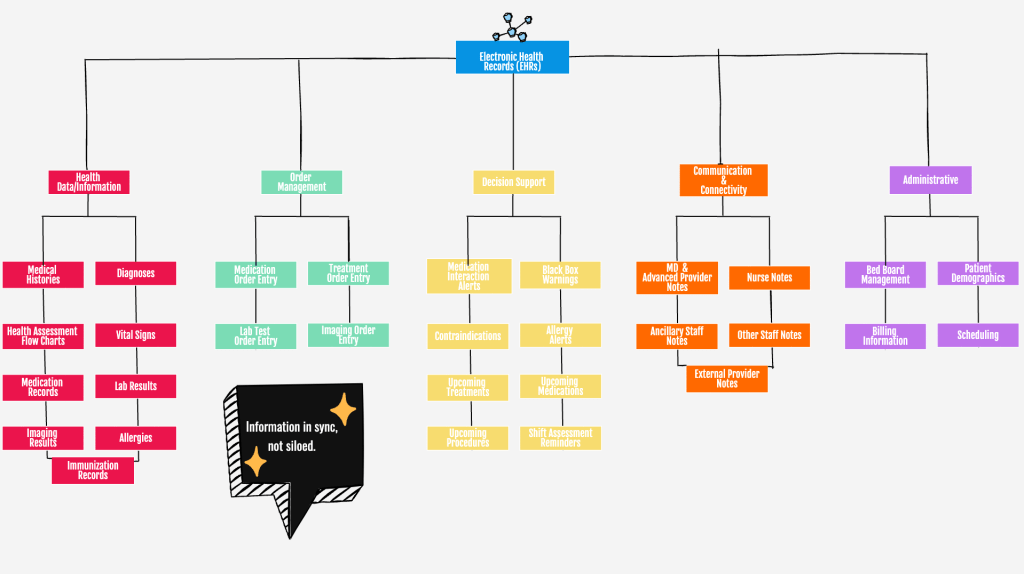
Though numerous components can make up an EHR, I believe certain key elements work together to form a functional and efficient framework for the digitized health record. The Key Capabilities of an Electronic Health Record System: Letter Report by the Institute of Medicine (2003) breaks down the EHR’s composition by the following core functionalities: health information and data, results management, order entry/order management, decision support, electronic communication and connectivity, patient support, administrative processes, and reporting and population health management. Moreover, these core functionalities consist of various tools like flow charts for vital signs and health assessments, medical histories encompassing physical and mental health, immunization records, and lists for medications and diagnoses to name a few of such key areas. Based on the Key Capabilities of an Electronic Health Record System: Letter Report (Institute of Medicine, 2003) and my own observations and experiences as a Registered Nurse, I considerthe visualization below to solidify what I believe to be some essential components that should be included in an ideal EHR system.
Visualization of Components
Component Descriptions
In the EHR visualization, one will notice that this idealized EHR framework consists of 5 key areas: health data/information, order management, decision support, communication and connectivity, and administrative functions.
“Health Data/Information” pertains to the patient’s most vital data and information. Viewing the “Medical Histories” (summaries of physical and mental health), “Diagnoses”, “Allergies,” “Medication Records”, and “Immunization Records” provide a holistic and comprehensive overview of the patient. Meanwhile, the healthcare professional’s ability to keep real-time documentation of patient information in the “Health Assessment Flow Charts” and “Vital Signs” sections allows others to understand and better differentiate the patient’s baseline condition from unusual and abnormal health trends and patterns and strategize how to address any areas of concern. “Lab Results” and “Imaging Results” utilize numerical ranges and images to provide an in-depth look into what is occurring within the patient at a physiological level.
“Order Management” comprises the order entry that doctors and other advanced providers perform. “Medication Order Entry” and “Treatment Order Entry” allow physicians and other providers to prescribe or furnish the necessary medications and treatments to better assist in achieving the patient’s health outcomes. Additionally, “Lab Test Order Entry” and “Imaging Order Entry” provide a way for advanced healthcare professionals to ensure that diagnostic measures are input to assist in the enhanced identification of health issues.
“Clinical Decision Support” characterizes a crucial area that enhances patient safety and prevents untoward health status changes or other complications in the patient. “Medication Interaction Alerts”, “Black Box Warnings,” “Contraindications,” and “Allergy Alerts are all medication-related pop-ups that occur before, during, and after the medication administration process. “Upcoming Medications,” “Upcoming Procedures,” and “Shift Assessment Reminders” provide prompts for healthcare professionals to be aware of and observe stringent scheduling protocol that best ensures the timely performance of related tasks associated with patient care.
Finally, “Administrative Functions” addresses the category of behind-the-scenes processes completed by staff members to organize and enhance the overall patient care experience. “Bed Board Management” refers to the specific system a hospital utilizes to manage their patient admissions, transfers, and discharges. “Patient Demographics” comprises sensitive information including a patient’s name and date of birth which are initially collected by intake staff. “Billing Information” includes the patient’s billing address and insurance coverage(s). “Scheduling” is key in assisting staff to keep track of and schedule appointments and provider visits to provide both routine check-ups and more acute care as befitting the patient’s health condition.
Usage Across the Ages
One of the notable features of EHRs is their ability to be customized to or utilize templates to better care for the specific populations that a particular hospital unit, outpatient clinic, or healthcare network serves. While adult patients with less extensive medical histories may require a more routine level of care, more vulnerable populations like pediatric and senior patients benefit from additional mechanisms to ensure their overall well-being and safety while addressing their age groups’ specific needs.
For example, itransition (2023) enumerates various integral components that are key to providing comprehensive care when working with pediatric patients. Growth and development charting tools provide essential measures of how young patients are experiencing development in the first years of their lives. Considering that many healthcare professionals are designated mandatory reporters, a child abuse reporting system is another key feature in assessing the degree of safety and quality of life that children and adolescents experience. Finally, pediatric patients require increased confidentiality and security in their EHRs that comply with protective measures set forth by the American Academy of Pediatrics and regulatory agencies.
Data Privacy and Confidentiality
Cybersecurity attacks and breaches affect all kinds of industries globally with the U.S. healthcare sector experiencing an alarming increase in privacy and confidentiality infringements in recent years. With numerous EHRs being hosted on cloud servers, such digitized health records are often targets of unauthorized persons or parties attempting to access, steal, sell, or ransom this protected health information (PHI) and other sensitive information. As part of the Health Insurance Portability and Accountability Act of 1996 (HIPAA), the U.S. government enforced the HIPAA Privacy Rule to “require specific protections to safeguard your electronic health information (HHS, n.d.).” Moreover, federal law mandates that healthcare entities and providers must notify patients, the Secretary of Health and Human Services, and in breaches affecting more than 500 residents of a state or jurisdiction, prominent media outlets must be informed of such data breaches (HHS, n.d.).
The U.S. Department of Health & Human Services (HHS) (n.d.) denotes the following 3 essential safeguards for data privacy and confidentiality purposes: access control tools, encryption, and an audit trail feature. Access control involves tools including passwords, PIN numbers, and badge access – various ways of accessing EHRs and utilizing key EHR functions. Encrypting characterizes how information is stored and transported, ensuring that information is not easily decrypted or identifiable. An “audit trail” feature allows authorized users to monitor which users accessed certain information and if and when any modifications to information were made.
Reflections:
Analyzing and visualizing the core components and aspects of an idealized EHR increased my understanding of and appreciation for these specialized healthcare documentation and management systems. As I consider returning to the healthcare field, this newfound knowledge will allow me to more keenly visualize and understand the multidisciplinary workflows and other beneficial processes made possible through such technologies. Undoubtedly, EHRs will continue to develop and transform the healthcare landscape. Enhanced communication, collaboration, and increased health information exchange (HIE) between healthcare professionals and information science professionals are integral to seeing EHRs assist in improving patients’ health outcomes and quality of life for all patients.
References
Institute of Medicine. (2003). Key capabilities of an Electronic Health Record System: Letter Report. Washington, DC: The National Academies Press. https://doi.org/10.17226/10781
itranstion. (2023, July 20). Pediatric EHR: Key features, benefits, and leading platforms. itransition. https://www.itransition.com/healthcare/ehr/pediatric
U.S. Department of Health and Human Services (HHS): Office for Civil Rights. (n.d.). Privacy, Security, and Electronic Health Records. HHS. https://www.hhs.gov/sites/default/files/ocr/privacy/hipaa/understanding/consumers/privacy-security-electronic-records.pdf
 Well Informed
Leave a comment